My Wardrobe
A WeChat Mini Program that recommends what to wear based on weather, context and personal comfort — then learns from feedback.
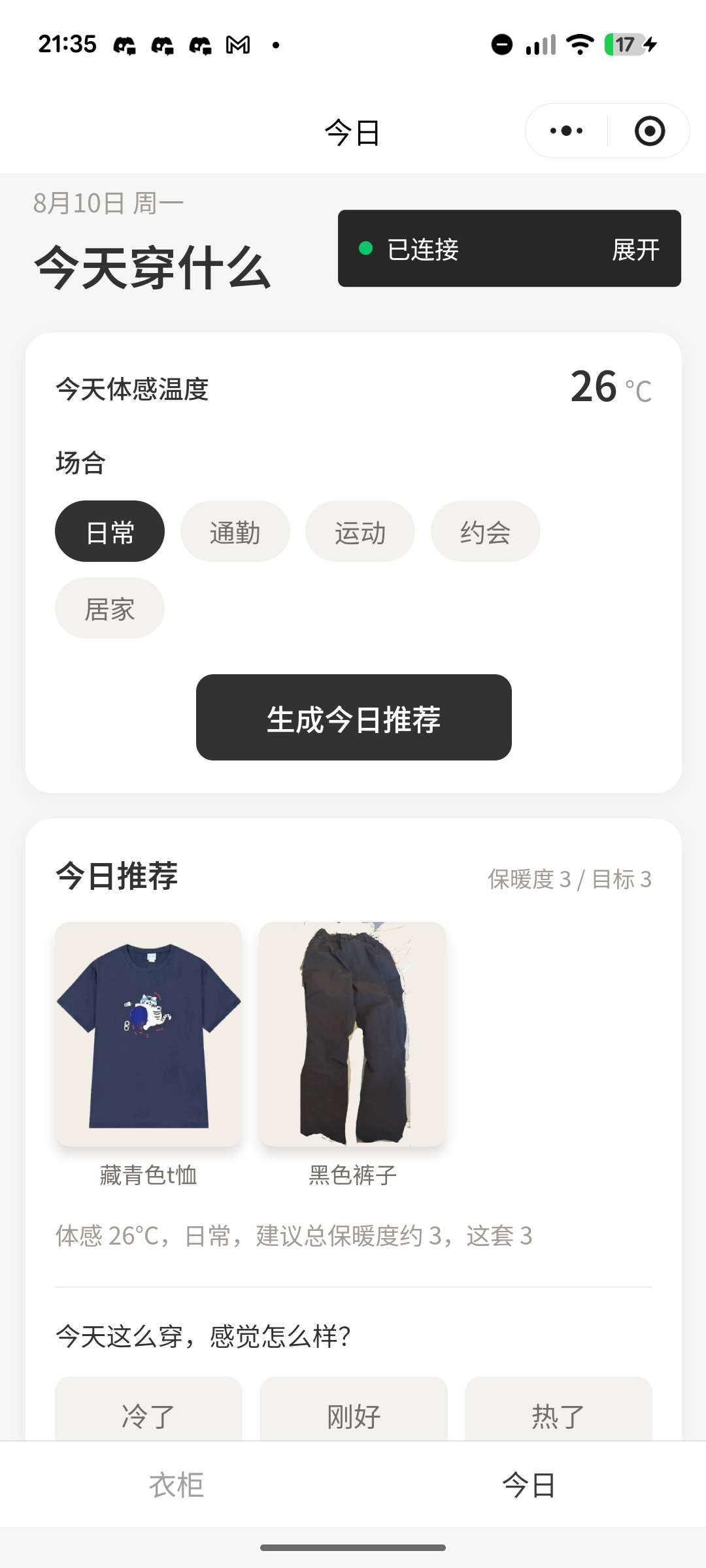
My Wardrobe turns the clothes someone already owns into a lightweight digital closet, then creates actionable outfit suggestions for the day's temperature and context.
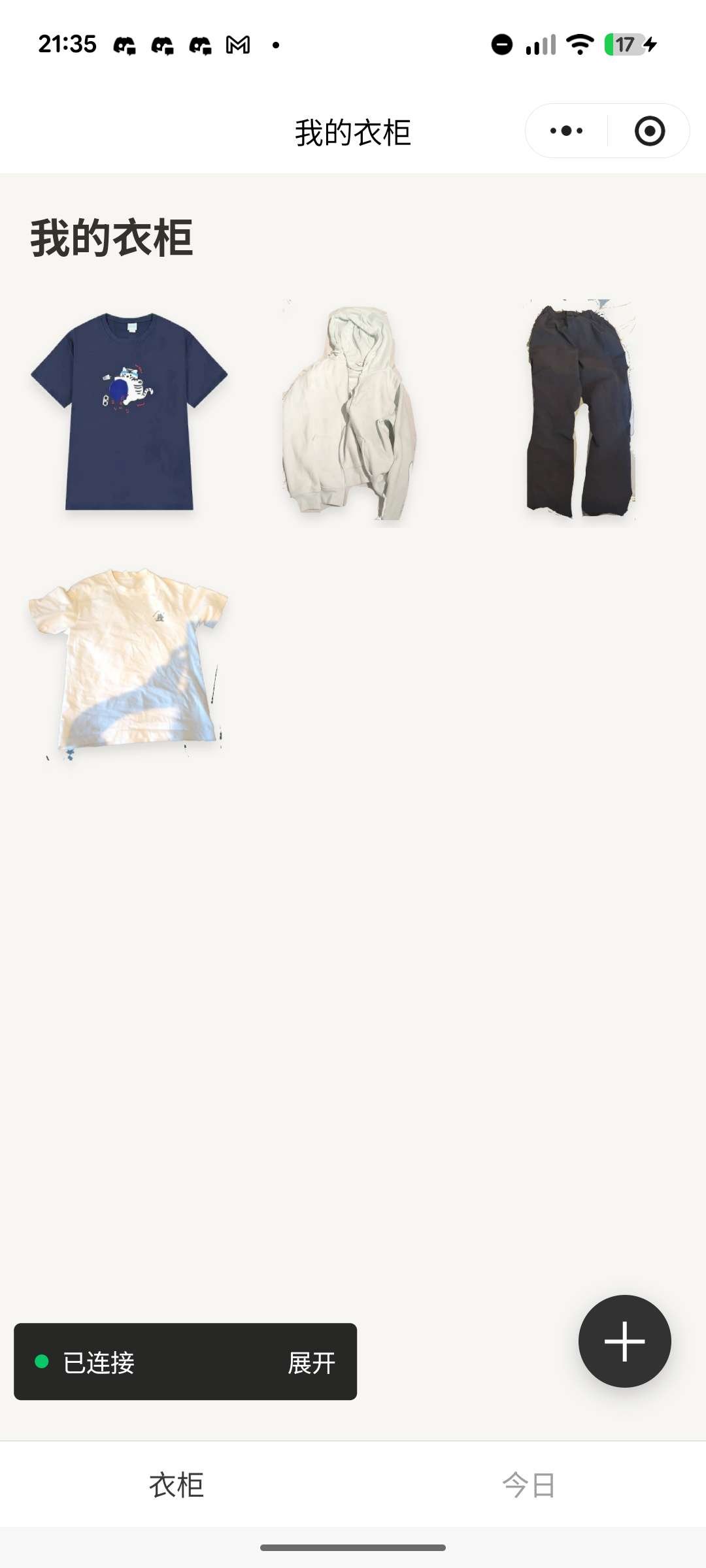
Garments appear as transparent stickers, keeping the closet direct, quiet and easy to scan — more like opening a real wardrobe than browsing a database.
The core is not a one-off smart recommendation, but a learning loop: at the end of the day, people report cold, comfortable or hot, gradually calibrating the system to their own body.
Working prototype · WeChat Mini ProgramWeather knows the temperature. It does not know how cold you feel.
Morning outfit decisions sit at the intersection of weather, context, available garments and individual sensitivity. The opportunity is to bring those scattered signals into one low-effort daily decision.
Design question: how might outfit advice move from generic weather guidance to a judgement that genuinely feels personal?
The recommendation is not the end. Feedback is what makes it better.
01 · Capture garments
Photograph, freely crop and create a transparent sticker with pre-filled attributes.
02 · Read the day
Combine feels-like temperature, weather and contexts such as commute or exercise.
03 · Recommend
Build an actionable outfit from clothes the user actually owns.
04 · Learn comfort
Calibrate the personal model through three low-effort comfort signals.
Keep intelligence understandable and controllable.
The garment is the navigation.
The main view removes cabinet decoration, card frames and labels. Details, editing and deletion stay one layer deeper, reducing visual noise.
Make context explicit before generation.
Choosing a context improves relevance and makes the recommendation logic visible.
Three answers are enough to begin personalising.
Cold, comfortable and hot are closer to lived experience than a complex rating, and light enough to repeat daily.
When automation fails, the experience should not fail with it.
Bedding, shadows, white T-shirts and dark trousers pushed colour-based background removal between too much residue and deleted garments. That limitation shifted the interaction from full automation to human-in-the-loop.
Freeform crop and conservative processing
Prioritise garment integrity over an apparently cleaner result.
Restore, erase, undo and reset
Every automated decision remains comparable, correctable and reversible.
Not every garment needs to pay the AI tax.
Current MVP: local, fast and correctable.
Photos stay on device with no per-image generation fee, while failed results remain manually recoverable.
Next hypothesis: GPT Image 2 garment standardisation.
Transform complex photos into consistent garment views and lighting, process and cache them in the background, while keeping the original and local version for comparison and fallback.
The key validation is whether generated results faithfully preserve patterns, logos, colour and construction details. AI refinement can be optional through credits or subscription rather than a mandatory cost for every user.
The biggest growth risk is asking too much before the first recommendation.
The next iteration will not ask people to digitise an entire wardrobe at once. It starts with 3–5 frequently worn garments, then progressively builds the closet after the first moment of value.
Future directions
Multi-select, continuous capture, product screenshot imports, background sticker generation, a free local baseline and paid AI refinement.
Validation metrics
Time to first garment, three-item completion, first-recommendation conversion, AI acceptance, manual repair and seven-day return.